


 AutoSimAn AlphaIQ product
Describe any system in plain language. Get a validated simulation.
AutoSim reads your description or PDF, writes the simulator, fits it by Bayesian calibration and scores it out-of-sample — in your browser, in minutes. Every number traces back to an executed computation.
See the process. Change the outcome.
The problem
Serious decisions run on simulation. Building one is broken.
- 6 months
- What a bank, insurer or supply-chain team spends building one production simulation model with a specialist quant team.
- $500K+
- Fully-loaded cost per model — before validation, documentation and model-risk review double it.
- 0 trust
- What an LLM-generated model earns from a risk committee: no calibration, no out-of-sample test, no audit trail.
The new failure mode: anyone can ask an AI for a model that looks right. Nobody can tell you if its numbers mean anything. The bottleneck moved from writing models to trusting them.
The solution
The AI writes the model. Executed code decides if it is right.
The AI does
- Reads your description or PDF
- Proposes parameters with literature citations
- Writes the Python simulator, streamed live
- Diagnoses failures and proposes repairs
Executed code does
- Runs real Python in your browser via WebAssembly
- Fits parameters by Bayesian calibration (ABC-SMC)
- Scores validity out-of-sample on held-out data
- Exports an auditable model-risk report
AI narrative is never folded into a numeric score. Every number traces to an executed computation.
What AutoSim simulates
Six families of model, one description away.
AutoSim is not a template gallery. It picks the modelling paradigm the system actually needs, writes the simulator, and calibrates it against your data.
'/%3e%3cg%20transform='translate(6.4,6.4)%20scale(0.8)'%3e%3ccircle%20cx='18'%20cy='18'%20r='4'%20stroke='%230B0B0D'%20stroke-width='3'%20fill='none'%20stroke-linecap='round'%20stroke-linejoin='round'/%3e%3ccircle%20cx='46'%20cy='18'%20r='4'%20stroke='%230B0B0D'%20stroke-width='3'%20fill='none'%20stroke-linecap='round'%20stroke-linejoin='round'/%3e%3ccircle%20cx='18'%20cy='46'%20r='4'%20stroke='%230B0B0D'%20stroke-width='3'%20fill='none'%20stroke-linecap='round'%20stroke-linejoin='round'/%3e%3ccircle%20cx='46'%20cy='46'%20r='4'%20stroke='%230B0B0D'%20stroke-width='3'%20fill='none'%20stroke-linecap='round'%20stroke-linejoin='round'/%3e%3ccircle%20cx='32'%20cy='32'%20r='5'%20fill='%230B0B0D'/%3e%3cpath%20d='M21%2021%20L28%2028%20M43%2021%20L36%2028%20M21%2043%20L28%2036%20M43%2043%20L36%2036'%20stroke='%230B0B0D'%20stroke-width='2'%20fill='none'/%3e%3c/g%3e%3c/svg%3e)
Agent-based models
Heterogeneous agents with behavioural rules, interacting on a grid, a network or a market. Emergent outcomes rather than assumed ones.
Traders, households, drivers, patients, firms
'/%3e%3cg%20transform='translate(6.4,6.4)%20scale(0.8)'%3e%3cellipse%20cx='32'%20cy='16'%20rx='16'%20ry='5.5'%20stroke='%230B0B0D'%20stroke-width='3'%20fill='none'%20stroke-linecap='round'%20stroke-linejoin='round'/%3e%3cpath%20d='M16%2016%20V48%20C16%2051%2023%2053.5%2032%2053.5%20C41%2053.5%2048%2051%2048%2048%20V16'%20stroke='%230B0B0D'%20stroke-width='3'%20fill='none'%20stroke-linecap='round'%20stroke-linejoin='round'/%3e%3cpath%20d='M20%2036%20l6%20-6%205%204%207%20-8%206%204'%20stroke='%230B0B0D'%20stroke-width='2.5'%20fill='none'%20stroke-linecap='round'%20stroke-linejoin='round'/%3e%3c/g%3e%3c/svg%3e)
Compartmental & system dynamics
Stocks, flows and feedback loops. Continuous or discrete time, fitted to observed trajectories rather than hand-tuned.
SIR epidemics, adoption curves, inventory loops
'/%3e%3cg%20transform='translate(6.4,6.4)%20scale(0.8)'%3e%3ccircle%20cx='32'%20cy='32'%20r='7'%20stroke='%230B0B0D'%20stroke-width='3'%20fill='none'%20stroke-linecap='round'%20stroke-linejoin='round'/%3e%3ccircle%20cx='32'%20cy='12'%20r='4'%20stroke='%230B0B0D'%20stroke-width='3'%20fill='none'%20stroke-linecap='round'%20stroke-linejoin='round'/%3e%3ccircle%20cx='52'%20cy='32'%20r='4'%20stroke='%230B0B0D'%20stroke-width='3'%20fill='none'%20stroke-linecap='round'%20stroke-linejoin='round'/%3e%3ccircle%20cx='32'%20cy='52'%20r='4'%20stroke='%230B0B0D'%20stroke-width='3'%20fill='none'%20stroke-linecap='round'%20stroke-linejoin='round'/%3e%3ccircle%20cx='12'%20cy='32'%20r='4'%20stroke='%230B0B0D'%20stroke-width='3'%20fill='none'%20stroke-linecap='round'%20stroke-linejoin='round'/%3e%3cpath%20d='M32%2016%20v9%20M48%2032%20h-9%20M32%2048%20v-9%20M16%2032%20h9'%20stroke='%230B0B0D'%20stroke-width='3'%20fill='none'%20stroke-linecap='round'%20stroke-linejoin='round'/%3e%3c/g%3e%3c/svg%3e)
Discrete-event & queueing
Arrivals, servers, capacity and waiting. Utilisation and tail latency come out of the run, not out of an average.
Triage, warehouse picking, call centres, ports
'/%3e%3cg%20transform='translate(6.4,6.4)%20scale(0.8)'%3e%3cpath%20d='M10%2032%20C14%2018%2018%2018%2022%2032%20C25%2042%2028%2042%2031%2032%20C33%2025%2036%2025%2038%2032%20C40%2037%2042%2037%2044%2032%20C45.5%2029%2047.5%2029%2049%2032%20H54'%20stroke='%230B0B0D'%20stroke-width='3'%20fill='none'%20stroke-linecap='round'%20stroke-linejoin='round'/%3e%3cpath%20d='M10%2014%20C24%2014%2038%2026%2054%2046'%20stroke='%230B0B0D'%20stroke-width='2'%20fill='none'%20stroke-dasharray='3%203'/%3e%3c/g%3e%3c/svg%3e)
Network diffusion & contagion
Spread over an explicit graph, with topology treated as a parameter you can stress rather than a fixed assumption.
Information cascades, default contagion, outages
'/%3e%3cg%20transform='translate(6.4,6.4)%20scale(0.8)'%3e%3cpath%20d='M12%2032%20L52%2014%20M12%2032%20L52%2024%20M12%2032%20L52%2040%20M12%2032%20L52%2050'%20stroke='%230B0B0D'%20stroke-width='3'%20fill='none'%20stroke-linecap='round'%20stroke-linejoin='round'/%3e%3cpath%20d='M52%2014%20C54%2026%2054%2038%2052%2050'%20stroke='%230B0B0D'%20stroke-width='2'%20fill='none'%20stroke-dasharray='3%203'/%3e%3ccircle%20cx='12'%20cy='32'%20r='3'%20fill='%230B0B0D'/%3e%3c/g%3e%3c/svg%3e)
Monte-Carlo risk ensembles
Thousands of stochastic paths from the calibrated model, returning full distributions, probability cones and tail measures.
VaR and ES, ruin probability, delay distributions
'/%3e%3cg%20transform='translate(6.4,6.4)%20scale(0.8)'%3e%3cpath%20d='M12%2050%20V12%20M12%2050%20H52'%20stroke='%230B0B0D'%20stroke-width='3'%20fill='none'%20stroke-linecap='round'%20stroke-linejoin='round'/%3e%3cpath%20d='M16%2046%20C20%2028%2032%2018%2050%2016'%20stroke='%230B0B0D'%20stroke-width='3'%20fill='none'%20stroke-linecap='round'%20stroke-linejoin='round'/%3e%3ccircle%20cx='30'%20cy='24.5'%20r='3.5'%20stroke='%230B0B0D'%20stroke-width='3'%20fill='none'%20stroke-linecap='round'%20stroke-linejoin='round'/%3e%3ccircle%20cx='30'%20cy='24.5'%20r='1.4'%20fill='%230B0B0D'/%3e%3c/g%3e%3c/svg%3e)
Policy & intervention search
Sweeps and optimisation on top of the simulator, so you compare interventions under the same uncertainty instead of one point forecast.
Pricing, staffing, lockdowns, rebalancing rules
Every family ships as readable Python, calibrated with ABC-SMC and scored out-of-sample — the paradigm changes, the evidence standard does not.
From one sentence to a running model
What you describe, what you get back.
- “Simulate how a two-week port strike moves my delivery times.”
- Discrete-event logistics model with capacity shocks, calibrated to your shipment history, returning a delay distribution per lane.
- “Model a flu outbreak in a city of 2 million with school closures.”
- Age-structured compartmental model with mobility, priors cited from literature, intervention timing as a swept parameter.
- “What happens to my order book if the two largest market makers withdraw?”
- Agent-based market microstructure model, calibrated to observed spread and depth, with a stressed-liquidity ensemble.
- “How much staffing do I need to keep ER waits under 30 minutes?”
- Queueing model of triage and beds, fitted to arrival logs, with a staffing sweep and the cheapest policy that holds.
The product
This is live today — not a mockup.
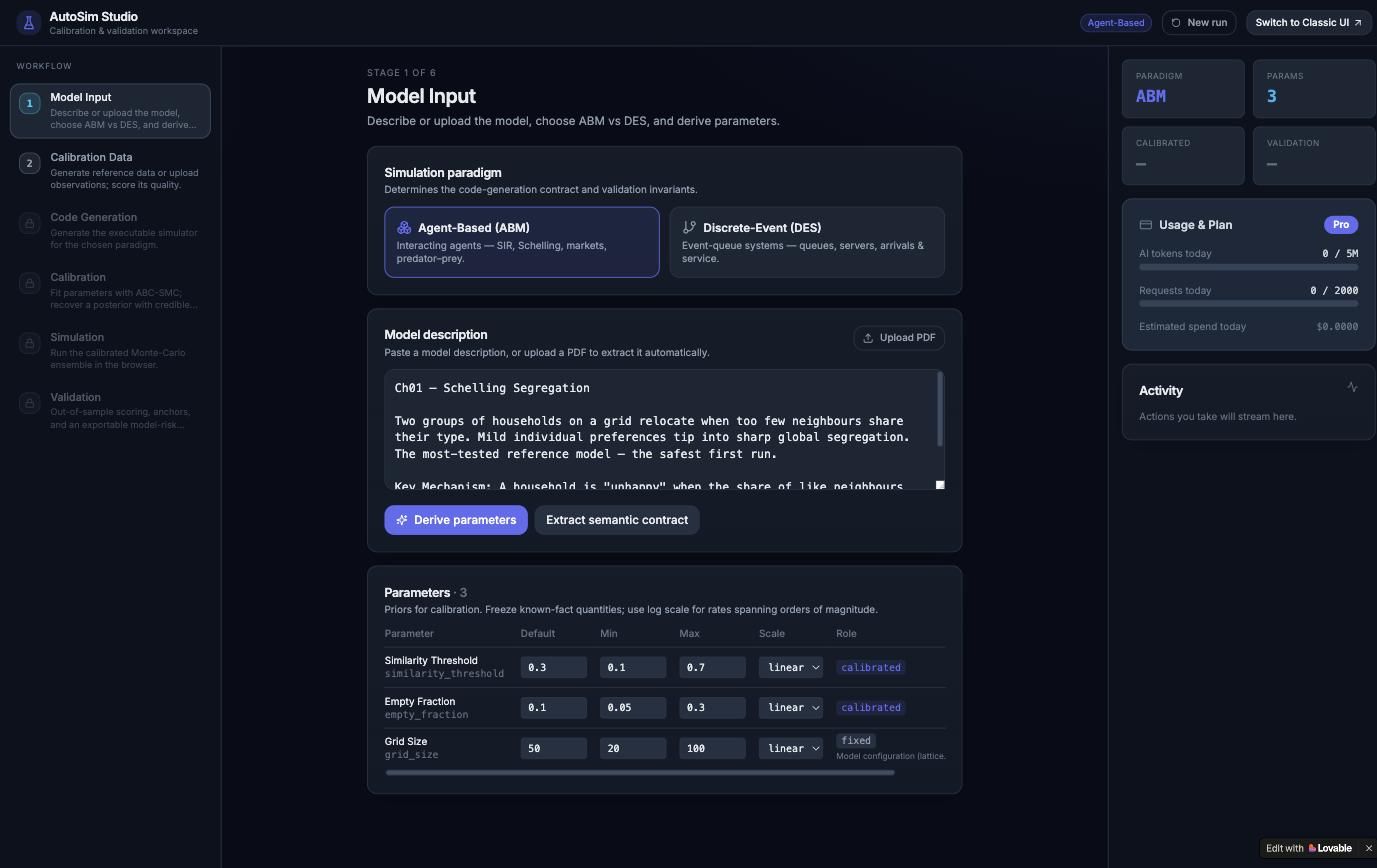
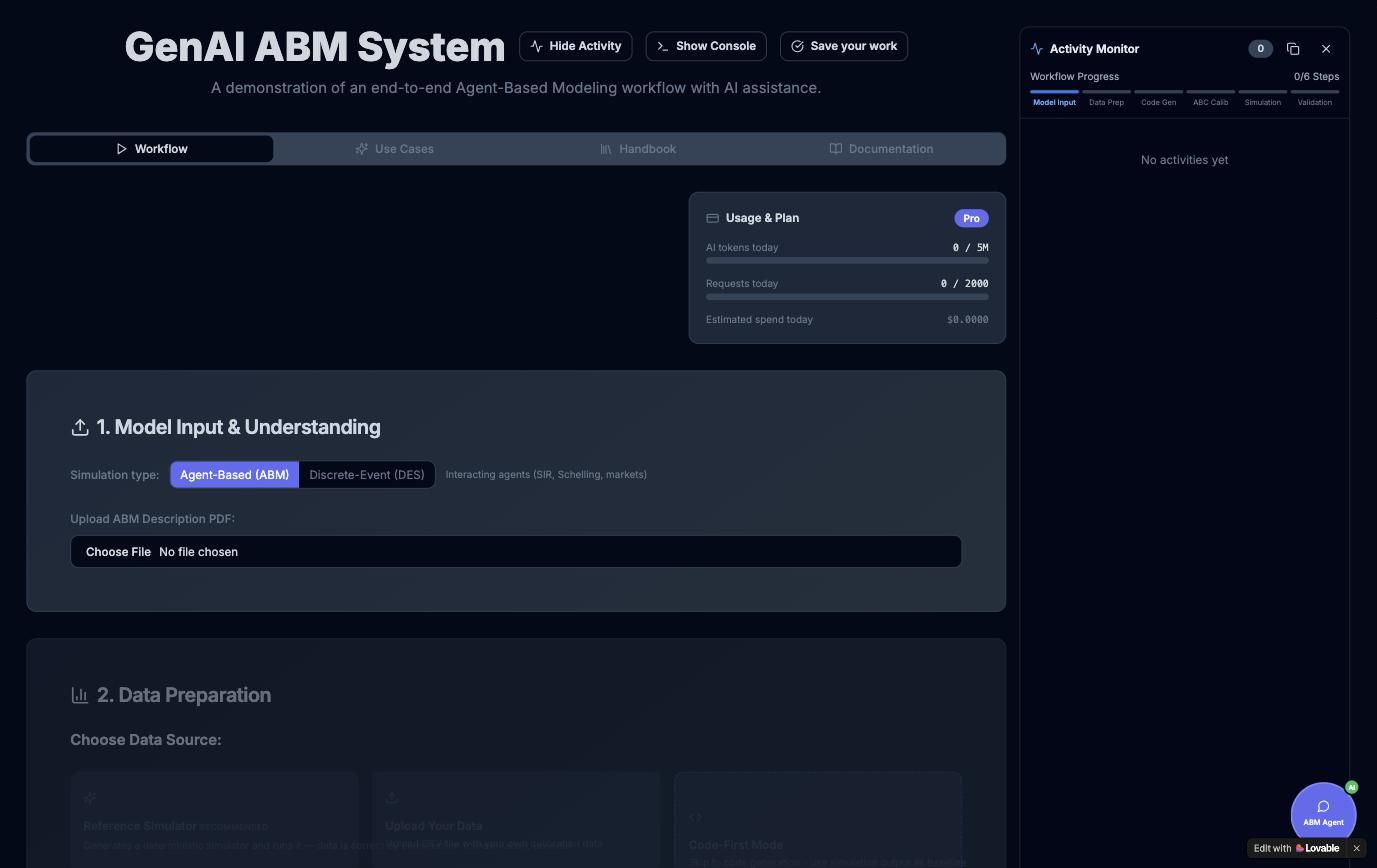
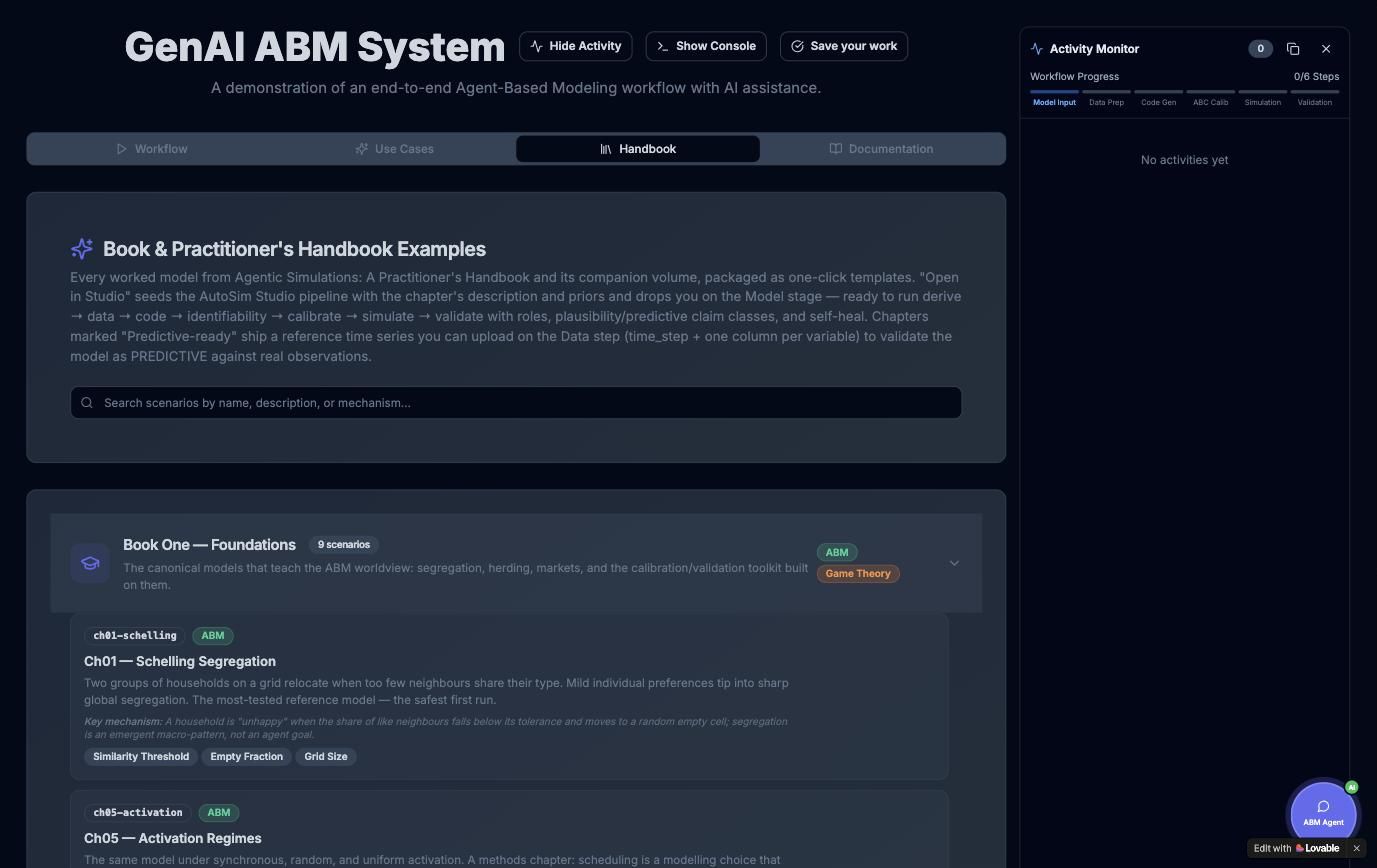
Pipeline, calibration, validation and billing are all in production right now.
See the proofPricing
Start free. The demo is the product.
Pro
$99 / mo
10M AI tokens / day
For power users: bigger models, priority AI, unlimited saved projects.
Enterprise
Custom
On-premises available
Model-risk reports, SSO, audit logs and private deployment. Priced per model-risk seat.
Simulations run in your browser, so compute is yours and pricing tracks AI usage — metered per user with quotas and live cost tracking.
AlphaIQ
AutoSim is how AlphaIQ ships its method.
AlphaIQ builds calibrated, validated agent-based simulations of the markets, portfolios and institutions our clients operate in. AutoSim is the self-serve product; bespoke engagements are the hands-on path for teams who want the model built with them.
Next step
Bring a system you need to defend.
Describe it in plain language and AutoSim will build, calibrate and score a simulation of it while you watch. If the question needs more than the product alone, AlphaIQ will build it with you.